Cooling coffee
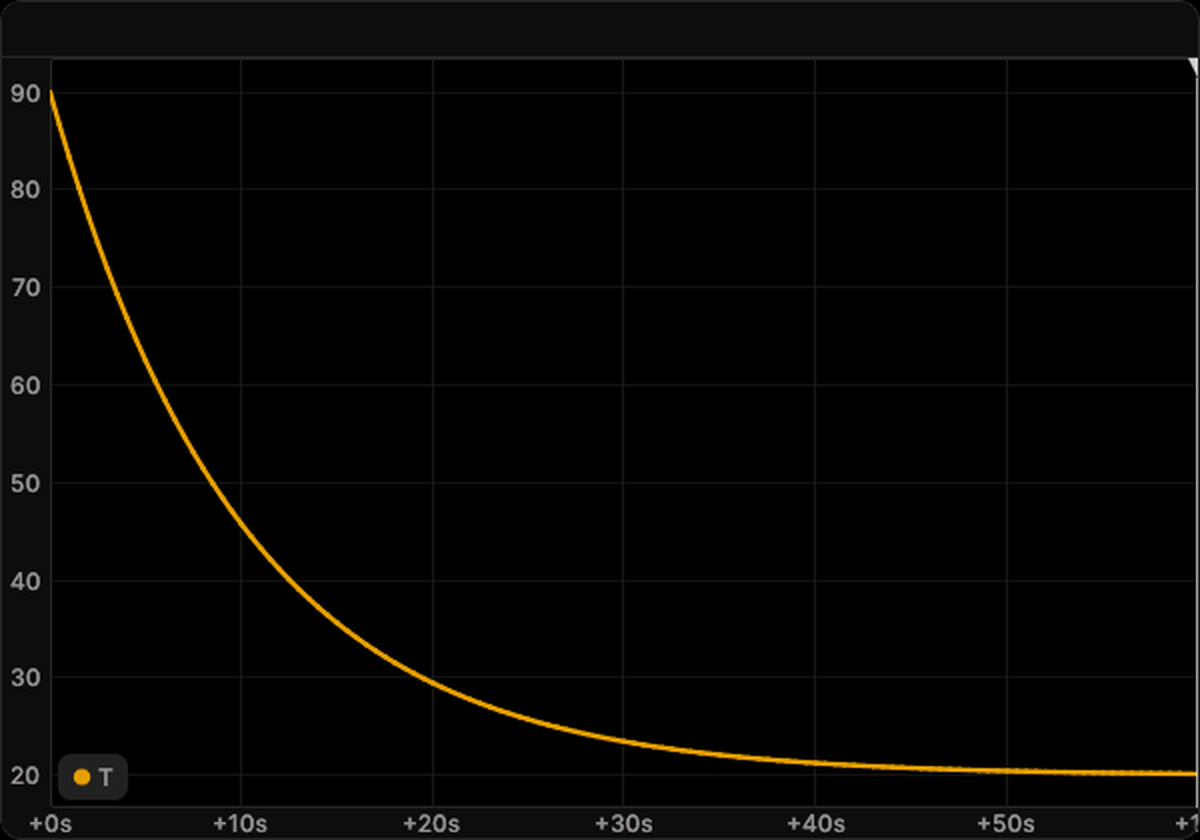
A cup of coffee whose temperature relaxes to that of the room, T' = -k (T - T_room).
- Name:
cooling_coffee - Field:
physics/heat - Formalism: ordinary differential equations
- References: Newton 1701; Meadows 2008
Factory
@register_model(
    field='physics/heat',
    tags=('heat', 'ode', 'balancing feedback', 'stocks and flows'),
    references=('Newton 1701', 'Meadows 2008'),
    defaults={'until': 60.0, 'dt': 0.5},
)
def cooling_coffee(T: float = 90.0, *, room: float = 20.0, k: float = 0.1) -> System:
    """Return a cup of coffee whose temperature relaxes to that of the room, `T' = -k (T - T_room)`.

    The heat flow is proportional to the discrepancy between the coffee and the room, a balancing feedback loop, so
    hot coffee cools and iced coffee warms, both exponentially with the time constant `1 / k`.

    Args:
        T:
            The initial temperature of the coffee.

        room:
            The temperature of the room.

        k:
            The rate of heat exchange.

    Returns:
        system:
            The model, with the temperature `coffee.T`.

    Examples:
        >>> from skcomplex.models.physics.heat import cooling_coffee
        >>> cooling_coffee(T=5.0).elements[0].T
        5.0
    """
    cooling = RelaxationInteraction(
        'cooling',
        target='coffee',
        state='T',
        goal=lambda s: s.target.room,
        time=lambda s: 1 / s.target.k,
    )
    return System(elements=[CoffeeCupElement('coffee', T=T, room=room, k=k)], interactions=[cooling])
Components
class CoffeeCupElement(Element):
    """Cup of coffee at the temperature `T` in a room at the temperature `room`, exchanging heat at the rate `k`.

    Args:
        label:
            The label of the cup.

        visual:
            How the cup is drawn, or `None` for none.

        T:
            The initial temperature of the coffee.

        room:
            The temperature of the room.

        k:
            The rate of heat exchange.

    Examples:
        >>> from skcomplex.models.physics.heat import CoffeeCupElement
        >>> CoffeeCupElement('coffee', k=0.2).k
        0.2
    """

    def __init__(
        self,
        label: str,
        visual: VisualSpec | None = None,
        *,
        T: Annotated[float, StateSpec()] = 90.0,
        room: Annotated[float, ParameterSpec()] = 20.0,
        k: Annotated[float, ParameterSpec(domain=RealSet.closed_open(0, oo))] = 0.1,
    ) -> None:
        super().__init__(label, visual=visual)
        self.T = T
        self.room = room
        self.k = k

class RelaxationInteraction(RateInteraction):
    """Relaxation `(goal(ns) - x) / time(ns)` of a state `x` of a target towards a goal, with optional noise.

    With a constant goal and time and an additive noise of amplitude `sigma`, the state follows the Ornstein-Uhlenbeck
    process `dx = (goal - x) / time dt + sigma dW`, whose stationary variance is `sigma**2 time / 2`. Without noise it
    is first-order smoothing, or adaptive expectation, towards the goal. A goal or a time function takes the namespace
    of the interaction, as for `RateInteraction`, and a number stands for a constant. A goal that is a number applies
    to every component of a vector state.

    Args:
        label:
            The label of the interaction, unique among the parts of its system.

        target:
            The path of the element or group whose state relaxes.

        state:
            The name of the state of the target that relaxes.

        goal:
            A function of the namespace that returns the goal, or a number.

        time:
            A function of the namespace that returns the relaxation time, or a positive number.

        noise:
            A function of the namespace that returns the amplitude of the noise, a number, or `None` for no noise.

    Raises:
        ValidationError:
            The state is not a name, or a function is neither callable nor a number.

    Examples:
        >>> from skcomplex.core.elements import CompartmentElement
        >>> from skcomplex.core.interactions import RelaxationInteraction
        >>> from skcomplex.core.system import System
        >>> from skcomplex.engine.runtime import Simulation
        >>> smoothing = RelaxationInteraction('smoothing', target='belief', state='n', goal=10.0, time=0.5)
        >>> system = System(elements=[CompartmentElement('belief', n=0.0)], interactions=[smoothing])
        >>> trajectory = Simulation(system, dt=0.01).check().prepare().run(until=5.0).trajectory_
        >>> round(float(trajectory.values('belief.n')[-1]), 3)
        10.0
    """

    def __init__(
        self,
        label: str,
        *,
        target: Annotated[str, RoleSpec()],
        state: str = 'x',
        goal: Callable[[SimpleNamespace], object] | float = 0.0,
        time: Callable[[SimpleNamespace], object] | float = 1.0,
        noise: Callable[[SimpleNamespace], object] | float | None = None,
    ) -> None:
        super().__init__(label, target=target, state=state, noise=noise)
        self.goal = goal
        self.time = time

    def _check_functions(self) -> None:
        """Raise an error for a state that is not a name, or a function that is neither callable nor a number."""
        super()._check_functions()
        for name in ('goal', 'time'):
            value = getattr(self, name)
            if not (callable(value) or isinstance(value, int | float)):
                error_msg = f'The {name} of {self.label!r} is {value!r}. Give a function of the namespace or a number.'
                raise ValidationError(error_msg)

    def _get_goal(self, namespace: SimpleNamespace) -> object:
        """Return the goal, the hook a subclass overrides to derive it from its parameters."""
        return self._evaluate(self.goal, namespace)

    def _get_time(self, namespace: SimpleNamespace) -> object:
        """Return the relaxation time, the hook a subclass overrides to derive it from its parameters."""
        return self._evaluate(self.time, namespace)

    def _get_rate(self, namespace: SimpleNamespace) -> object:
        """Return the relaxation `(goal - x) / time` of the state.

        Args:
            namespace:
                The namespace of the symbols the rate can use.

        Returns:
            rate:
                The rate of the state.
        """
        state = getattr(self._get_member(namespace, 'target'), self.state)
        goal = self._broadcast(self._get_goal(namespace), state)
        return (goal - state) / self._get_time(namespace)
Equations
coffee.T: diff(T_coffee(t), t) == k_coffee*(room_coffee - T_coffee(t))