Automata on the free group
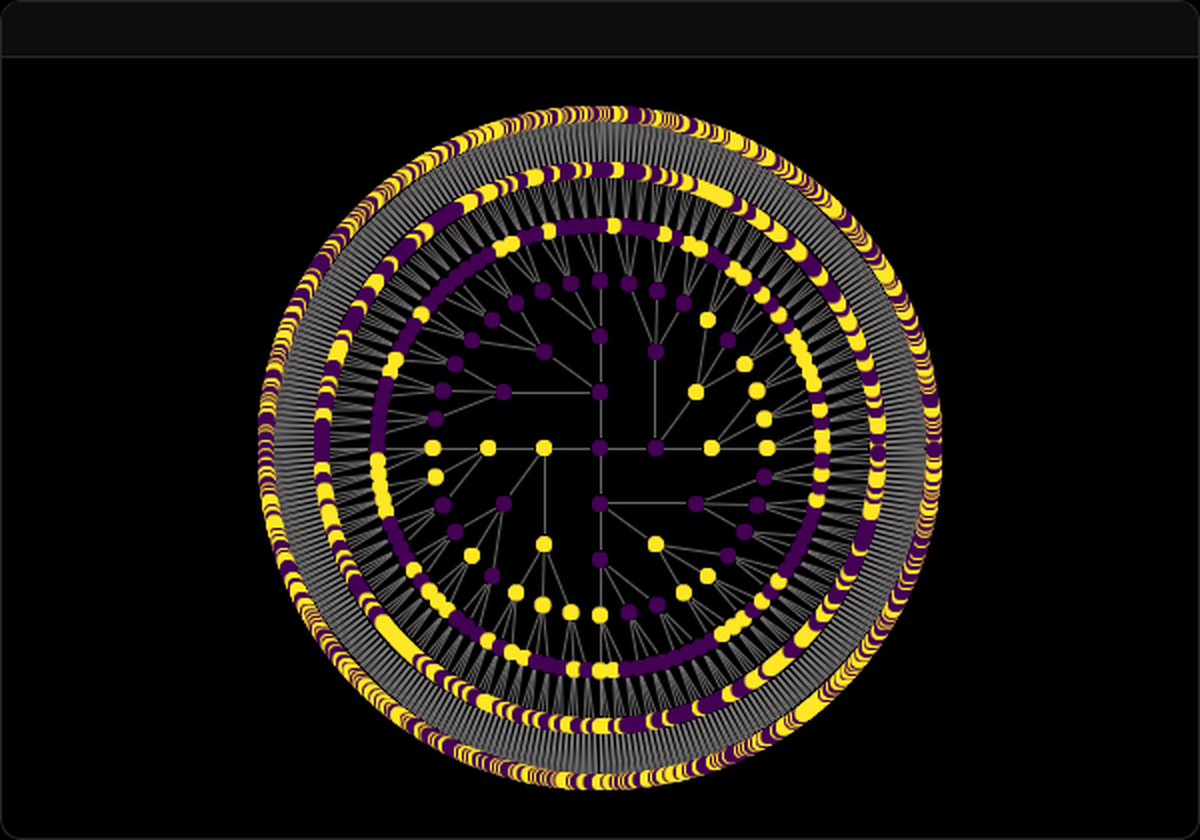
The majority automaton on a ball of the free group, a tree in which every cell follows its neighbours.
- Name:
free_group_automaton - Field:
computer_science/automata - Formalism: lattice dynamics
- References: Ceccherini-Silberstein and Coornaert 2023
Factory
@register_model(
    field='computer_science/automata',
    tags=('group', 'cellular automaton', 'majority', 'free group'),
    references=('Ceccherini-Silberstein and Coornaert 2023',),
    defaults={'until': 20, 'dt': 1},
    observables=_density_observables,
)
def free_group_automaton(
    rank: int = 2,
    *,
    radius: int = 6,
    density: float = 0.5,
    random_state: int | np.random.Generator | None = 0,
) -> System:
    """Return the majority automaton on a ball of the free group, a tree in which every cell follows its neighbours.

    Every cell reads itself and the cells at its generators and their inverses, and takes the majority value, so the
    random start freezes into blocks of agreeing cells. Cells on the boundary count only their neighbours inside the
    ball.

    Args:
        rank:
            The number of generators.

        radius:
            The radius of the ball.

        density:
            The probability that a cell starts at 1.

        random_state:
            The seed or generator of the initial cells.

    Returns:
        system:
            The model, with the cells `cells.alive`.

    Examples:
        >>> from skcomplex.models.computer_science.automata import free_group_automaton
        >>> free_group_automaton(radius=3).elements[0].check().prepare().size_
        53
    """
    space = CayleySpace(free_group(rank), ball=radius)
    return _majority_system(
        space,
        GeneratorNeighborhood(space.check().prepare().generators_),
        density,
        random_state,
    )
Components
class BinaryCellElement(Element):
    """Cell of an automaton whose state `alive` is 0 or 1, changed by the local rule of an interaction.

    Args:
        label:
            The label of the cell or the lattice group.

        visual:
            How the element is drawn, or `None` for `default_visual_`.

        alive:
            The initial value, 0 or 1.

    Examples:
        >>> from skcomplex.models.computer_science.automata import BinaryCellElement
        >>> BinaryCellElement('cell', alive=1).alive
        1
    """

    def __init__(
        self,
        label: str,
        visual: VisualSpec | None = None,
        *,
        alive: Annotated[float, StateSpec(domain=FiniteEnumeratedSet([0, 1]))] = 0,
    ) -> None:
        super().__init__(label, visual=visual)
        self.alive = alive

class LocalRuleInteraction(Interaction):
    """Local rule of a cellular automaton, which sets the next value of every cell from its ordered neighbourhood.

    The rule is a table of the next value of every configuration of the neighbourhood, `TableSpec`, a rule of the sum
    of the neighbourhood, `TotalisticSpec`, a rule of the cell and the sum of its neighbours, `OuterTotalisticSpec`, an
    object whose `table()` returns a `TableSpec`, or a function. A function receives one array per neighbour of every
    read state, in neighbourhood order, with one value per cell, the uniform array `random` when the rule is stochastic,
    and the parameters of the bound group it names, and returns the next values of the states, one array per state.

    Args:
        label:
            The label of the interaction, unique among the parts of its system.

        target:
            The path of the group on the cells of a lattice, the nodes of a network, or a Cayley graph.

        state:
            The name of the state the rule sets, or a tuple of the names of the states it sets together.

        rule:
            The table, the totalistic rule, or the function.

        neighborhood:
            The ordered neighbourhood of every cell, such as `VonNeumannNeighborhood(center=True)`.

        reads:
            The names of the states whose neighbourhoods a function reads, or `None` for the states it sets.

        schedule:
            `'synchronous'`, `'random-sequential'`, `'random-site'`, `'checkerboard'`, or `'colored'`.

        stochastic:
            Whether a function receives the uniform random array `random`.

    Raises:
        ValidationError:
            The state or the read states are not names, or the neighbourhood is not a neighbourhood.

    Examples:
        >>> from skcomplex.core.interactions import LocalRuleInteraction
        >>> from skcomplex.core.spaces import VonNeumannNeighborhood
        >>> from skcomplex.specs import TotalisticSpec
        >>> parity = TotalisticSpec({1: 1, 3: 1})
        >>> around = VonNeumannNeighborhood(n_dim=1, center=True)
        >>> rule = LocalRuleInteraction('parity', target='cells', state='cell', rule=parity, neighborhood=around)
        >>> rule.check().schedule
        'synchronous'
    """

    def __init__(
        self,
        label: str,
        *,
        target: Annotated[str, RoleSpec()],
        state: str | tuple[str, ...],
        rule: object,
        neighborhood: BaseNeighborhood,
        reads: Sequence[str] | None = None,
        schedule: str = 'synchronous',
        stochastic: bool = False,
    ) -> None:
        super().__init__(label)
        self.target = target
        self.state = state
        self.rule = rule
        self.neighborhood = neighborhood
        self.reads = reads
        self.schedule = schedule
        self.stochastic = stochastic

    def _get_names(self) -> tuple[str, ...]:
        """Return the names of the states the rule sets."""
        return (self.state,) if isinstance(self.state, str) else tuple(self.state)

    def _check(self) -> None:
        """Raise an error for states that are not names, or a neighbourhood that is not one.

        Raises:
            ValidationError:
                The state or the read states are not names, or the neighbourhood is not a neighbourhood.
        """
        super()._check()
        names = [*self._get_names(), *(self.reads or ())]
        if not names or not all(isinstance(name, str) and name.isidentifier() for name in names):
            error_msg = f'The local rule {self.label!r} sets {self.state!r} and reads {self.reads!r}. Give state names.'
            raise ValidationError(error_msg)
        if not isinstance(self.neighborhood, BaseNeighborhood):
            error_msg = f'The neighbourhood of the local rule {self.label!r} is {self.neighborhood!r}. Give one.'
            raise ValidationError(error_msg)

    def _get_laws(self, namespace: SimpleNamespace) -> list[BaseLaw]:
        """Return the local rule law of the states of the target.

        Args:
            namespace:
                The namespace of the symbols the laws can use, with `namespace.target`.

        Returns:
            laws:
                The local rule law.
        """
        targets = tuple(getattr(self._get_member(namespace, 'target'), name) for name in self._get_names())
        reads = (
            None
            if self.reads is None
            else tuple(getattr(self._get_member(namespace, 'target'), name) for name in self.reads)
        )
        return [
            LocalRuleLaw(
                targets[0] if isinstance(self.state, str) else targets,
                self.neighborhood,
                self.rule,
                reads=reads,
                schedule=self.schedule,
                stochastic=self.stochastic,
                label=self.label,
            ),
        ]