Note
Click here to download the full example code
Memristor oscillator
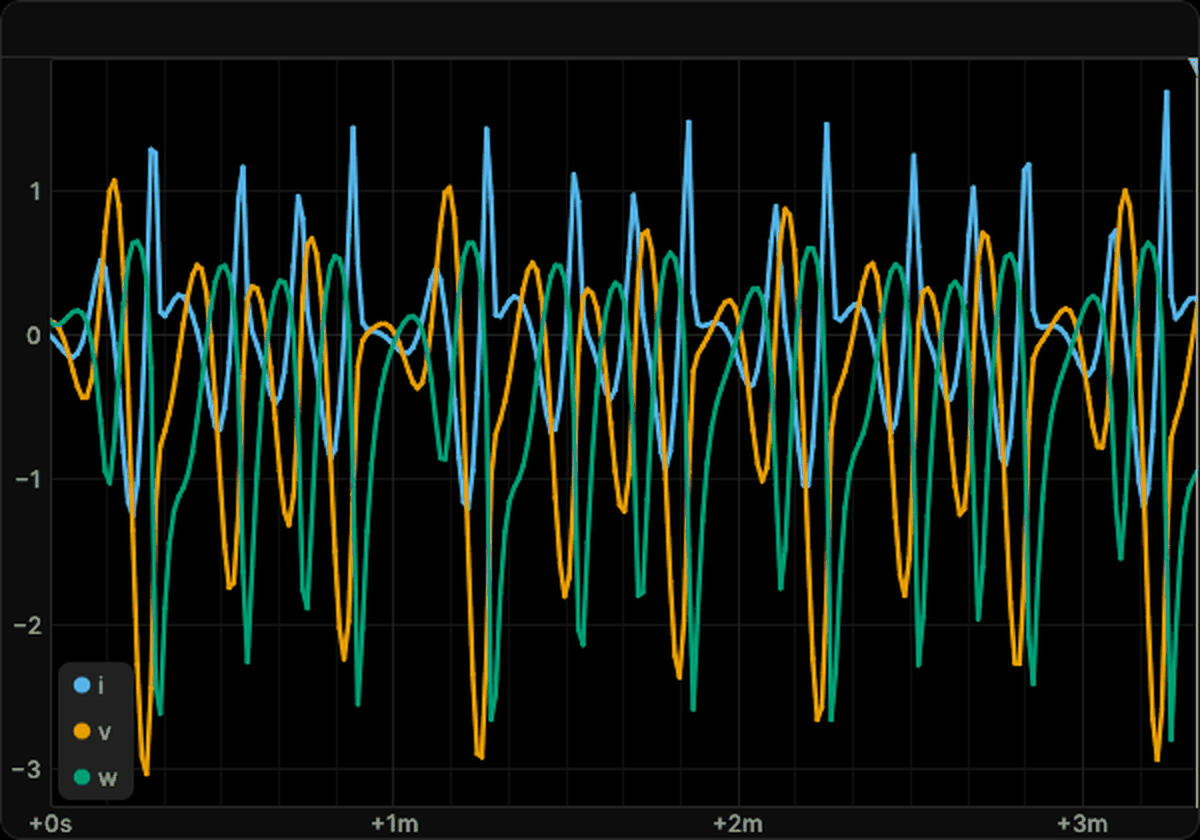
A capacitor, an inductor, and a memristor in series are enough for chaos: the memristance changes with the current that has flowed through it, and the voltage oscillates with irregular, never-repeating amplitudes.
The example builds MemristorOscillatorSystem with C = 1, L = 3, alpha = 0.6, and beta = 1.5, and runs for
200 time units. The default blueprint shows the voltage, the current, and the memristor state in one time series
view.
import matplotlib.pyplot as plt

from skcomplex.core.analysis import lyapunov
from skcomplex.core.engine.viz import RerunObserver
from skcomplex.systems.engineering.circuits import MemristorOscillatorSystem

SYSTEM = 'memristor_oscillator'

system = MemristorOscillatorSystem()
observer = RerunObserver(SYSTEM, save_path=f'{SYSTEM}.rrd', blueprint='default', interval=8)
trajectory = system.prepare().simulate(observers=[observer])
Open the recording in the Rerun viewer
A chaotic attractor
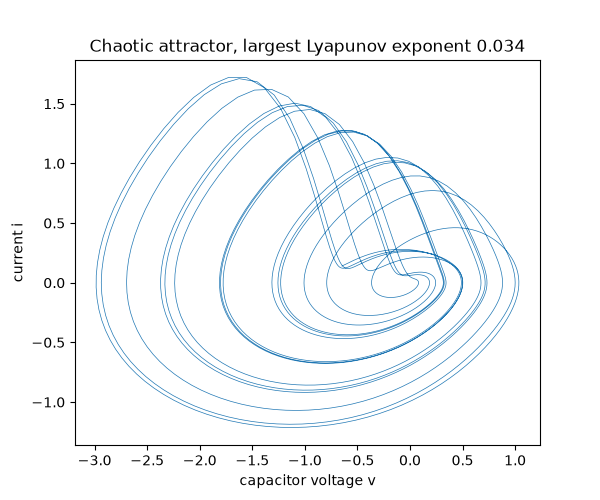
The trajectory should fill a band in the voltage-current plane instead of closing on a cycle, and the largest Lyapunov exponent of the flow should be positive.
settled = trajectory.times > 20
exponent = lyapunov(system, n_exponents=1, until=500.0, dt=0.01).exponents[0]
fig, ax = plt.subplots(figsize=(6, 5))
ax.plot(trajectory.get_values('circuit.v')[settled], trajectory.get_values('circuit.i')[settled], linewidth=0.5)
ax.set_xlabel('capacitor voltage v')
ax.set_ylabel('current i')
ax.set_title(f'Chaotic attractor, largest Lyapunov exponent {exponent:.3f}')
plt.show()
About the system
The simplest memristor oscillator.
References
- Muthuswamy and Chua 2010
- Trzaska 2023
Total running time of the script: ( 0 minutes 2.564 seconds)
Download Python source code: plot_memristor_oscillator.py