Note
Click here to download the full example code
Majority automaton on the Baumslag-Solitar group
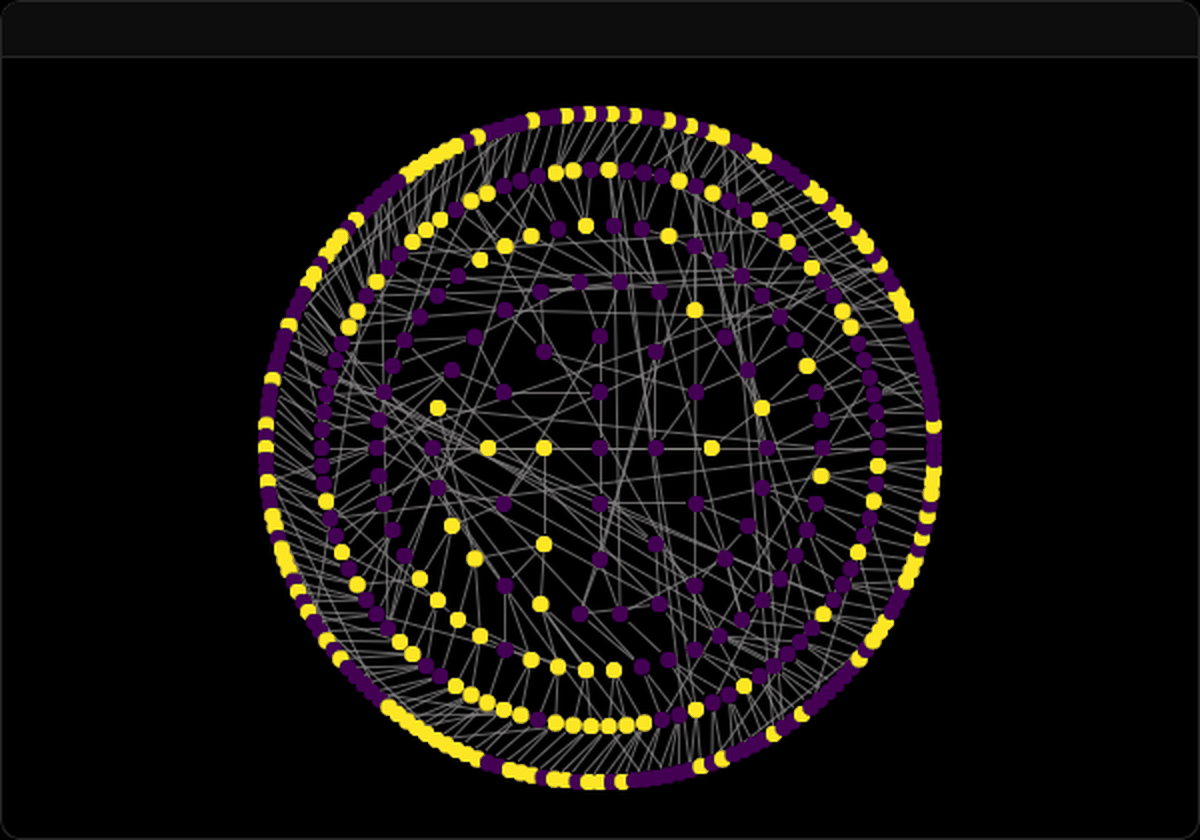
The cells sit on a ball of radius 6 of the Baumslag-Solitar group BS(1, 2) = <a, t | t a t^-1 = a^2>, built from a
confluent rewriting system that Knuth-Bendix completion in GAP finds. Each cell takes the majority value of itself and
its neighbours along a, a^-1, t, and t^-1 inside the ball, so the random start freezes into clusters within a
few steps.
The ball's elements sit on rings by word length, colored by their state.
import matplotlib.pyplot as plt
import numpy as np

from skcomplex.engine.runtime import Simulation
from skcomplex.engine.viz import RerunObserver
from skcomplex.models import create

MODEL = 'baumslag_solitar_automaton'

system = create(MODEL, radius=6, density=0.5, random_state=0)
observer = RerunObserver(MODEL, save_path=f'{MODEL}.rrd', blueprint='default')
simulation = Simulation(system, observers=[observer]).check().prepare().run(until=20)
Open the recording in the Rerun viewer
Exponential growth and freezing
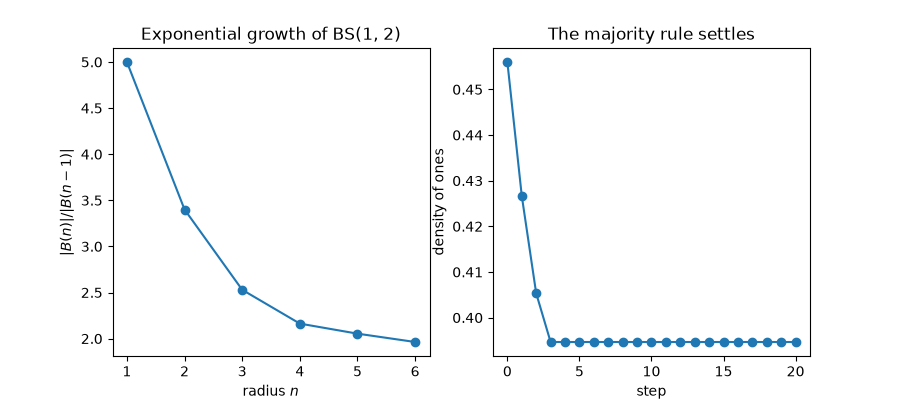
BS(1, 2) is solvable but not virtually nilpotent, so its balls grow exponentially, slower than those of the free
group of rank 2. The ratio of consecutive ball sizes should approach a constant below 3, and the density of ones
should settle after a few steps.
space = system.elements[0].space
sizes = np.asarray(space.ball_sizes_, dtype=float)
alive = simulation.trajectory_.values('cells.alive')
fig, (left, right) = plt.subplots(1, 2, figsize=(9, 4))
left.plot(np.arange(1, sizes.size), sizes[1:] / sizes[:-1], 'o-')
left.set_xlabel('radius $n$')
left.set_ylabel('$|B(n)| / |B(n - 1)|$')
left.set_title('Exponential growth of BS(1, 2)')
right.plot(simulation.trajectory_.times, alive.mean(axis=1), 'o-')
right.set_xlabel('step')
right.set_ylabel('density of ones')
right.set_title('The majority rule settles')
plt.show()
About the model
The majority automaton on a ball of the Baumslag-Solitar group BS(m, n), of exponential growth.
References
- Ceccherini-Silberstein and Coornaert 2023
- Baumslag and Solitar 1962
Total running time of the script: ( 0 minutes 6.066 seconds)
Download Python source code: plot_baumslag_solitar_automaton.py
Download Jupyter notebook: plot_baumslag_solitar_automaton.ipynb