Baumslag-Solitar groups
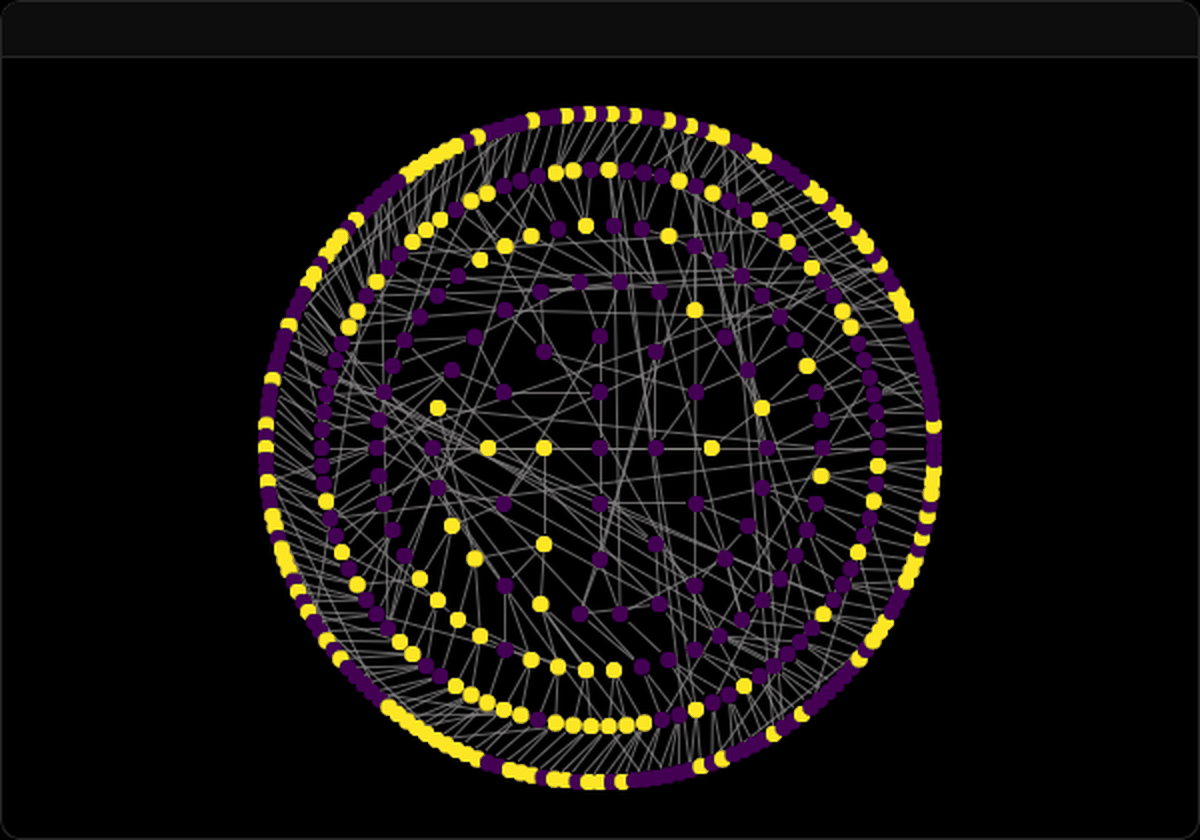
The majority automaton on a ball of the Baumslag-Solitar group BS(m, n), of exponential growth.
- Name:
baumslag_solitar_automaton - Field:
computer_science/automata - Formalism: lattice dynamics
- References: Ceccherini-Silberstein and Coornaert 2023; Baumslag and Solitar 1962
Factory
@register_model(
    field='computer_science/automata',
    tags=('group', 'cellular automaton', 'majority', 'solvable'),
    references=('Ceccherini-Silberstein and Coornaert 2023', 'Baumslag and Solitar 1962'),
    defaults={'until': 20, 'dt': 1},
    observables=_density_observables,
)
def baumslag_solitar_automaton(
    m: int = 1,
    n: int = 2,
    *,
    radius: int = 6,
    density: float = 0.5,
    random_state: int | np.random.Generator | None = 0,
) -> System:
    """Return the majority automaton on a ball of the Baumslag-Solitar group `BS(m, n)`, of exponential growth.

    Every cell reads itself and the cells at `a`, `a^-1`, `t`, and `t^-1`, and takes the majority value. The ball is
    built from a confluent rewriting system of the presentation, which GAP finds for `BS(1, n)`.

    Args:
        m:
            The exponent of `a` conjugated by `t`.

        n:
            The exponent it is conjugated to.

        radius:
            The radius of the ball.

        density:
            The probability that a cell starts at 1.

        random_state:
            The seed or generator of the initial cells.

    Returns:
        system:
            The model, with the cells `cells.alive`.

    Examples:
        >>> from skcomplex.models.computer_science.automata import baumslag_solitar_automaton
        >>> baumslag_solitar_automaton(radius=2).elements[0].check().prepare().size_
        17
    """
    space = CayleySpace(baumslag_solitar(m, n), ball=radius)
    return _majority_system(
        space,
        GeneratorNeighborhood(space.check().prepare().generators_),
        density,
        random_state,
    )
Components
class BinaryCellElement(Element):
    """Cell of an automaton whose state `alive` is 0 or 1, changed by the local rule of an interaction.

    Args:
        label:
            The label of the cell or the lattice group.

        visual:
            How the element is drawn, or `None` for `default_visual_`.

        alive:
            The initial value, 0 or 1.

    Examples:
        >>> from skcomplex.models.computer_science.automata import BinaryCellElement
        >>> BinaryCellElement('cell', alive=1).alive
        1
    """

    def __init__(
        self,
        label: str,
        visual: VisualSpec | None = None,
        *,
        alive: Annotated[float, StateSpec(domain=FiniteEnumeratedSet([0, 1]))] = 0,
    ) -> None:
        super().__init__(label, visual=visual)
        self.alive = alive

class LocalRuleInteraction(Interaction):
    """Local rule of a cellular automaton, which sets the next value of every cell from its ordered neighbourhood.

    The rule is a table of the next value of every configuration of the neighbourhood, `TableSpec`, a rule of the sum
    of the neighbourhood, `TotalisticSpec`, a rule of the cell and the sum of its neighbours, `OuterTotalisticSpec`, an
    object whose `table()` returns a `TableSpec`, or a function. A function receives one array per neighbour of every
    read state, in neighbourhood order, with one value per cell, the uniform array `random` when the rule is stochastic,
    and the parameters of the bound group it names, and returns the next values of the states, one array per state.

    Args:
        label:
            The label of the interaction, unique among the parts of its system.

        target:
            The path of the group on the cells of a lattice, the nodes of a network, or a Cayley graph.

        state:
            The name of the state the rule sets, or a tuple of the names of the states it sets together.

        rule:
            The table, the totalistic rule, or the function.

        neighborhood:
            The ordered neighbourhood of every cell, such as `VonNeumannNeighborhood(center=True)`.

        reads:
            The names of the states whose neighbourhoods a function reads, or `None` for the states it sets.

        schedule:
            `'synchronous'`, `'random-sequential'`, `'random-site'`, `'checkerboard'`, or `'colored'`.

        stochastic:
            Whether a function receives the uniform random array `random`.

    Raises:
        ValidationError:
            The state or the read states are not names, or the neighbourhood is not a neighbourhood.

    Examples:
        >>> from skcomplex.core.interactions import LocalRuleInteraction
        >>> from skcomplex.core.spaces import VonNeumannNeighborhood
        >>> from skcomplex.specs import TotalisticSpec
        >>> parity = TotalisticSpec({1: 1, 3: 1})
        >>> around = VonNeumannNeighborhood(n_dim=1, center=True)
        >>> rule = LocalRuleInteraction('parity', target='cells', state='cell', rule=parity, neighborhood=around)
        >>> rule.check().schedule
        'synchronous'
    """

    def __init__(
        self,
        label: str,
        *,
        target: Annotated[str, RoleSpec()],
        state: str | tuple[str, ...],
        rule: object,
        neighborhood: BaseNeighborhood,
        reads: Sequence[str] | None = None,
        schedule: str = 'synchronous',
        stochastic: bool = False,
    ) -> None:
        super().__init__(label)
        self.target = target
        self.state = state
        self.rule = rule
        self.neighborhood = neighborhood
        self.reads = reads
        self.schedule = schedule
        self.stochastic = stochastic

    def _get_names(self) -> tuple[str, ...]:
        """Return the names of the states the rule sets."""
        return (self.state,) if isinstance(self.state, str) else tuple(self.state)

    def _check(self) -> None:
        """Raise an error for states that are not names, or a neighbourhood that is not one.

        Raises:
            ValidationError:
                The state or the read states are not names, or the neighbourhood is not a neighbourhood.
        """
        super()._check()
        names = [*self._get_names(), *(self.reads or ())]
        if not names or not all(isinstance(name, str) and name.isidentifier() for name in names):
            error_msg = f'The local rule {self.label!r} sets {self.state!r} and reads {self.reads!r}. Give state names.'
            raise ValidationError(error_msg)
        if not isinstance(self.neighborhood, BaseNeighborhood):
            error_msg = f'The neighbourhood of the local rule {self.label!r} is {self.neighborhood!r}. Give one.'
            raise ValidationError(error_msg)

    def _get_laws(self, namespace: SimpleNamespace) -> list[BaseLaw]:
        """Return the local rule law of the states of the target.

        Args:
            namespace:
                The namespace of the symbols the laws can use, with `namespace.target`.

        Returns:
            laws:
                The local rule law.
        """
        targets = tuple(getattr(self._get_member(namespace, 'target'), name) for name in self._get_names())
        reads = (
            None
            if self.reads is None
            else tuple(getattr(self._get_member(namespace, 'target'), name) for name in self.reads)
        )
        return [
            LocalRuleLaw(
                targets[0] if isinstance(self.state, str) else targets,
                self.neighborhood,
                self.rule,
                reads=reads,
                schedule=self.schedule,
                stochastic=self.stochastic,
                label=self.label,
            ),
        ]