Tunnel-diode oscillator
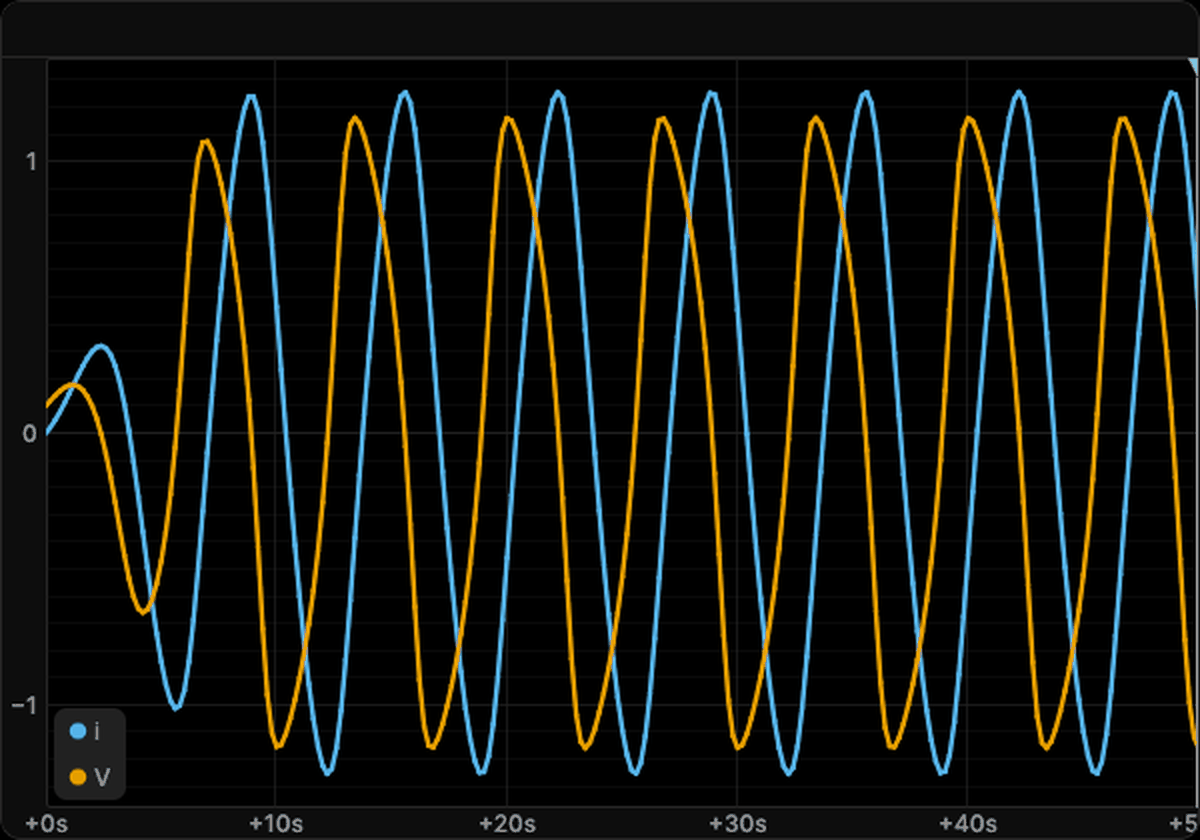
A tunnel-diode oscillator: an inductor and a capacitor in parallel with a negative-resistance diode.
- Name:
tunnel_diode_oscillator - Field:
engineering/circuits - Formalism: ordinary differential equations
- References: van der Pol 1926; Trzaska 2023
Factory
@register_model(
    field='engineering/circuits',
    tags=('circuit', 'oscillation', 'limit cycle', 'ode'),
    references=('van der Pol 1926', 'Trzaska 2023'),
    defaults={'until': 50.0, 'dt': 0.05},
)
def tunnel_diode_oscillator(
    V: float = 0.1,
    i: float = 0.0,
    *,
    L: float = 1.0,
    C: float = 1.0,
    alpha: float = 1.0,
    gamma: float = 1.0,
) -> System:
    """Return a tunnel-diode oscillator: an inductor and a capacitor in parallel with a negative-resistance diode.

    The diode current is `h(V) = gamma V^3 - alpha V`, so Kirchhoff's laws give `C V' = -h(V) - i` and `L i' = V`,
    which is the van der Pol oscillator with `ε = alpha sqrt(L / C)`. The voltage settles on a limit cycle of
    amplitude near `2 sqrt(alpha / (3 gamma))`.

    Args:
        V:
            The initial voltage.

        i:
            The initial current of the inductor.

        L:
            The inductance.

        C:
            The capacitance.

        alpha:
            The negative conductance of the diode at zero voltage.

        gamma:
            The cubic coefficient of the diode.

    Returns:
        system:
            The model, with the voltage `circuit.V` and the inductor current `circuit.i`.

    Examples:
        >>> from skcomplex.models.engineering.circuits import tunnel_diode_oscillator
        >>> tunnel_diode_oscillator(alpha=2.0).elements[0].alpha
        2.0
    """
    return System(elements=[TunnelDiodeCircuitElement('circuit', V=V, i=i, L=L, C=C, alpha=alpha, gamma=gamma)])
Components
class TunnelDiodeCircuitElement(Element):
    """Oscillator of a tunnel diode with a cubic current, of the van der Pol type."""

    def __init__(
        self,
        label: str,
        visual: VisualSpec | None = None,
        *,
        V: Annotated[object, StateSpec()] = 0.1,
        i: Annotated[object, StateSpec()] = 0.0,
        L: Annotated[object, ParameterSpec(domain=RealSet.open(0, oo))] = 1.0,
        C: Annotated[object, ParameterSpec(domain=RealSet.open(0, oo))] = 1.0,
        alpha: Annotated[object, ParameterSpec(domain=RealSet.open(0, oo))] = 1.0,
        gamma: Annotated[object, ParameterSpec(domain=RealSet.open(0, oo))] = 1.0,
    ) -> None:
        super().__init__(label, visual=visual)
        self.V = V
        self.i = i
        self.L = L
        self.C = C
        self.alpha = alpha
        self.gamma = gamma

    def _get_laws(self, s: SimpleNamespace) -> list[BaseLaw]:
        """Return the rates of the states of the circuit."""
        return [
            RateLaw(s.V, -(s.gamma * s.V**3 - s.alpha * s.V + s.i) / s.C),
            RateLaw(s.i, s.V / s.L),
        ]
Equations
circuit.V: diff(V_circuit(t), t) == -(gamma_circuit*V_circuit(t)^3 - alpha_circuit*V_circuit(t) + i_circuit(t))/C_circuit
circuit.i: diff(i_circuit(t), t) == V_circuit(t)/L_circuit