Note
Click here to download the full example code
A source of your own
This example shows BaseStatsSource, BaseOddsSource, RawItem and RawPayload. It writes a feed for a league the library does not know.
# Author: Georgios Douzas <gdouzas@icloud.com>
# Licence: MIT

import io

import matplotlib.pyplot as plt
import pandas as pd

from sportsbet.sources import BaseOddsSource, BaseStatsSource, RawItem, RawPayload, derive_market_outcomes

IDENTITY = ['date', 'league', 'division', 'year', 'home_team', 'away_team']
MARKETS = ['home_win', 'draw', 'away_win']
A source describes a feed
A source says what to read and how to turn it into snapshots. It never fetches. The dataloader reads the items the source declares. So a source stays a plain description of a feed. It is easy to write and to test.
class MyStats(BaseStatsSource):
    """Statistics from a feed of your own."""

    name = 'my_stats'
    sport = 'soccer'

    def list_index_items(self, selection=None):
        return [RawItem(source=self.name, key='seasons', url='https://example.com/seasons.json')]

    def read_catalogue(self, payloads):
        return [{'league': 'Ruritania', 'division': 1, 'year': 2025}]

    def list_required_items(self, params, schedule=None):
        return [
            RawItem(
                source=self.name,
                key=f'Ruritania_1_{param["year"]}',
                url=f'https://example.com/{param["year"]}.csv',
            )
            for param in params
        ]

    def to_snapshots(self, payloads):
        games = pd.read_csv(io.BytesIO(payloads[0].content))
        games['date'] = pd.to_datetime(games['date'], utc=True)  # the kick-off, in UTC
        preplay = games[IDENTITY].assign(event_status='preplay', event_time=0, home_form=games['home_form'])
        postplay = games[IDENTITY].assign(event_status='postplay', event_time=0)
        outcomes = derive_market_outcomes(games['home_goals'], games['away_goals'], MARKETS)
        return pd.concat([preplay, pd.concat([postplay, outcomes], axis=1)], ignore_index=True)
The source declares what it needs. The dataloader reads it.
source = MyStats()
source.list_required_items([{'year': 2025}])[0]
Out:
RawItem(source='my_stats', key='Ruritania_1_2025', url='https://example.com/2025.csv')
The source turns the returned bytes into snapshots. Here we hand it a payload directly. The dataloader would hand it the same payload.
csv = b'date,league,division,year,home_team,away_team,home_form,home_goals,away_goals\n'
csv += b'2025-08-16,Ruritania,1,2025,A,B,0.5,2,1\n'
snapshots = source.to_snapshots([RawPayload(item=source.list_required_items([{'year': 2025}])[0], content=csv)])
snapshots
Out:
                       date     league  division  ...  home_win draw away_win
0 2025-08-16 00:00:00+00:00  Ruritania         1  ...       NaN  NaN      NaN
1 2025-08-16 00:00:00+00:00  Ruritania         1  ...       1.0  0.0      0.0

[2 rows x 12 columns]
The odds are a source too
The markets are its columns. The bookmaker is its provider column. So nothing has to be registered anywhere. Drop
draw and you have a sport that cannot be drawn. The bettor works out the two-way market on its own.
class MyOdds(BaseOddsSource):
    """Odds from a feed of your own."""

    name = 'my_odds'
    sport = 'soccer'

    def list_index_items(self, selection=None):
        return [RawItem(source=self.name, key='seasons', url='https://example.com/seasons.json')]

    def read_catalogue(self, payloads):
        return [{'league': 'Ruritania', 'division': 1, 'year': 2025}]

    def list_required_items(self, params, schedule=None):
        return [
            RawItem(source=self.name, key=f'odds_{param["year"]}', url=f'https://example.com/odds/{param["year"]}.csv')
            for param in params
        ]

    def to_snapshots(self, payloads):
        odds = pd.read_csv(io.BytesIO(payloads[0].content))
        odds['date'] = pd.to_datetime(odds['date'], utc=True)
        return odds.assign(event_status='preplay', event_time=0)
csv = b'date,league,division,year,home_team,away_team,provider,home_win,draw,away_win\n'
csv += b'2025-08-16,Ruritania,1,2025,A,B,acme,1.8,3.4,4.2\n'
odds_source = MyOdds()
odds_source.to_snapshots([RawPayload(item=odds_source.list_required_items([{'year': 2025}])[0], content=csv)])
Out:
                       date     league  ...  event_status  event_time
0 2025-08-16 00:00:00+00:00  Ruritania  ...       preplay           0

[1 rows x 12 columns]
Give both to a dataloader. Then everything on the other pages applies to them:
from sportsbet.dataloaders import DataLoader

dataloader = DataLoader(stats=MyStats(), odds=MyOdds())
X, Y, O = dataloader.extract_train_data(odds_type='acme')
Four rules matter here:
- Never fetch. A source that could fetch might download during an extraction by accident.
dateis the kick-off instant in UTC. Convert your feed's time zone at your own boundary.- Fixtures come from
list_fixtures_items. It defaults to the training items. Override it only when the upcoming matches live in a different file than the finished seasons. - Credentials go in
request_url, never in aRawItem. The transform sees the item, and you save the item.
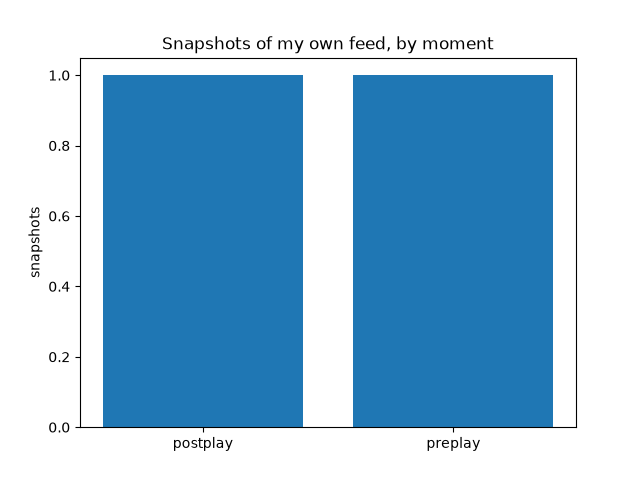
A picture of it
moments = snapshots.groupby('event_status').size()

fig, ax = plt.subplots()
ax.bar(moments.index, moments.to_numpy())
ax.set_title('Snapshots of my own feed, by moment')
ax.set_ylabel('snapshots')
Out:
Text(42.722222222222214, 0.5, 'snapshots')
Total running time of the script: ( 0 minutes 0.088 seconds)
Download Python source code: plot_custom_source.py